
How Much Do Sweatpants and Sweatshirts Weigh?
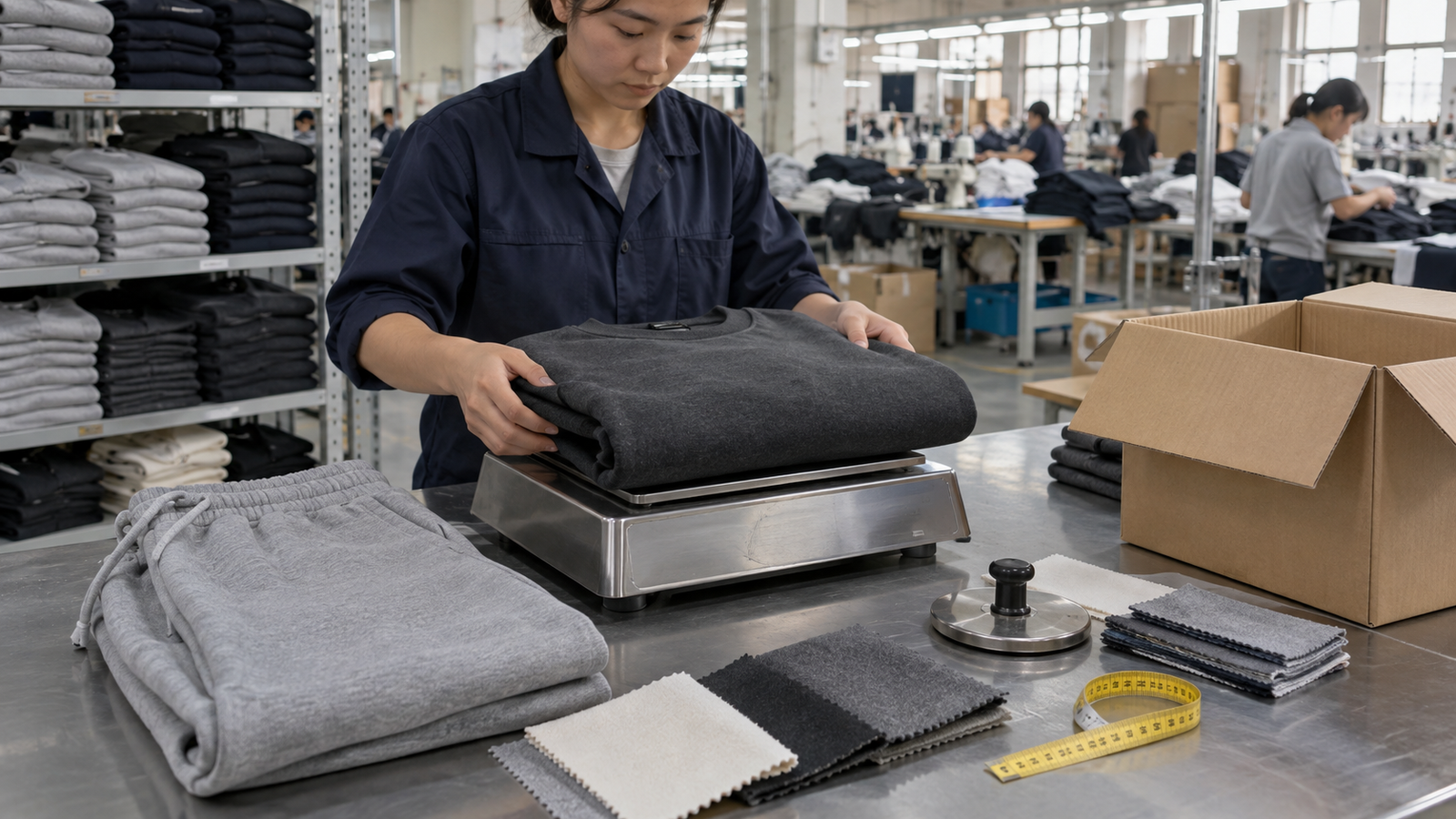
Navigating the complexities of apparel manufacturing and logistics can be challenging, especially when seemingly minor details like garment weight can significantly impact your bottom line. Unpredictable shipping costs and material usage can quickly erode profit margins, leaving businesses scrambling to adjust. Understanding how much sweatpants and sweatshirts weigh is crucial for accurate planning and cost control.
On average, a single pair of adult sweatpants can weigh anywhere from 0.7 to 1.5 pounds (approximately 320g to 680g), while an adult sweatshirt typically weighs between 0.8 to 2.0 pounds (approximately 360g to 900g)[^1]. These ranges vary significantly based on factors such as fabric composition, GSM (grams per square meter), garment size, and design elements.
While these figures offer a helpful starting point, a multitude of factors contribute to the final weight of these popular garments. Let's delve into the specific variables that influence how much your sweatpants and sweatshirts will ultimately weigh, and why this knowledge is vital for your procurement and logistics strategies.
What Factors Influence Sweatpant and Sweatshirt Weight?
Many businesses overlook the nuances of garment weight until they face unexpected shipping costs or material discrepancies. This oversight can lead to budget overruns and inefficiencies in production planning. Accurately predicting the weight of sweatpants and sweatshirts requires a deep understanding of their construction.
The weight of sweatpants and sweatshirts is primarily influenced by fabric type and density (GSM), garment size, design features like pockets or hoods, and the blend of materials used.[^2] Each of these elements contributes directly to the overall mass of the finished product.
When we discuss garment weight in a manufacturing context, we are often talking about "finished garment weight" – the weight of the item as it would be shipped. This is distinct from fabric weight alone. From my experience working with various brands, even small differences per unit can accumulate to significant impacts on large orders.
Fabric Type and Density (GSM)
The fundamental determinant of how much sweatpants and sweatshirts weigh is the fabric itself. Sweatshirts and sweatpants are typically made from fleece, French terry, or similar knit fabrics. These fabrics can vary significantly in their "grams per square meter" (GSM) – a direct measure of fabric density.[^3]
- Fleece: This fabric often has a brushed interior, making it soft and warm. It can range from lighter-weight fleece (e.g., 200-250 GSM) used for milder climates or activewear, to heavy-weight fleece (e.g., 350-450+ GSM) for ultimate warmth.[^4] Higher GSM fleece will result in heavier garments.
- French Terry: Characterized by loops on one side and soft piles on the other, French terry typically has a moderate weight, often falling between 250-350 GSM.[^5] It offers breathability while still providing comfort.
- Blends: Fabric blends, such as cotton-polyester or cotton-spandex, also play a role. Polyester is generally lighter than cotton for the same thermal properties[^6], while spandex adds elasticity without adding substantial weight unless used in high percentages.
Let's consider an example: a basic cotton French terry fabric might be 280 GSM. If we switch to a heavy cotton-polyester fleece at 400 GSM, the garment made from the heavier fabric will be substantially heavier, assuming the same pattern. Manufacturers, like us at Dongguan Pro Sportswear, meticulously track GSM to ensure consistent product weight and quality for our B2B clients. This allows for precise material estimation and cost calculation.
Garment Size and Cut
It's intuitive that a larger garment will weigh more, but the extent of this difference can sometimes be underestimated. A men's 2XL hooded sweatshirt will consume considerably more fabric than a women's S crewneck. Similarly, wide-leg sweatpants will be heavier than slim-fit joggers.
- Size Grading: When a garment pattern is "graded" (scaled up or down for different sizes), the amount of fabric required changes. An industry standard might see a roughly 5-10% increase in fabric consumption per size increment[^7], impacting the final weight.
- Cut and Silhouette: A baggy, oversized fit for sweatpants or a relaxed-fit sweatshirt will naturally use more fabric than a tailored, slim-fit design. This isn't just about size; it's about the garment's overall volume and drape.
When ordering, it’s critical for buyers to consider the intended size range and fit profiles. Our R&D team works closely with clients to optimize fabric usage across different sizes, balancing desired aesthetics with weight and cost efficiency.
Design Features and Hardware
Beyond the basic fabric, various design elements and added components can accumulate to increase the final weight of sweatpants and sweatshirts.
- Hoods: A prominent feature of many sweatshirts, hoods add significant fabric weight.[^8] If the hood is double-lined or includes drawstrings and eyelets, its contribution to the overall weight increases further.
- Pockets: Kangaroo pockets on sweatshirts or side and back pockets on sweatpants add extra layers of fabric. Zippered pockets, especially with metal zippers, introduce additional weight.
- Drawstrings and Cords: While seemingly minor, drawstrings for hoods and waistbands, especially thick or braided ones, can add a few grams. If they have metal aglets (tips), that weight increases.
- Zippers, Buttons, and Snaps: Full-zip sweatshirts or sweatpants with button closures will be heavier than pullover styles or elastic-waist designs due to the added hardware. The material of the zipper (plastic vs. metal) also makes a difference.
- Embellishments: Embroidery, large screen prints, appliques, or heavy patches can add noticeable weight, particularly if they cover a large area or use dense materials.
Comparative Impact of Features on Garment Weight
| Feature/Style | Typical Weight Impact (Relative) | Notes |
|---|---|---|
| Basic Crewneck | Baseline | Minimal additions |
| Hooded Sweatshirt (Single) | +5-10% | Adds fabric for hood |
| Hooded Sweatshirt (Double) | +10-15% | Lined hood adds more fabric |
| Full-Zip Sweatshirt | +5-10% | Zipper hardware and extra fabric for placket |
| Kangaroo Pocket | +2-5% | Additional fabric layer |
| Side Seam Pockets | +2-3% | Less fabric than kangaroo, but still adds weight |
| Thick Drawstrings/Aglets | +1-2% | Can be noticeable, especially if metal tips are used |
| Heavy Embroidery | Varies greatly | Depends on stitch density and size; can add significant weight |
| Lightweight Sweatpants | Baseline | Simple, minimal features |
| Cargo Sweatpants | +10-20% | Multiple pockets, extra fabric |
| Sweatpants with Zippers | +5-10% | Hardware adds weight |
By carefully considering each of these factors, procurement teams can better estimate the true weight of their customized sportswear orders, which is critical for budgeting and logistics planning.
Why Does the Weight of Sweatpants and Sweatshirts Matter for Your Business?
Many B2B buyers might initially focus on aesthetics and cost per unit, but overlooking the weight of sweatpants and sweatshirts can lead to unforeseen expenses and operational inefficiencies. This can particularly impact profitability for large-volume orders.
The weight of sweatpants and sweatshirts is crucial for businesses primarily because it directly influences shipping costs, material costs, and manufacturing efficiency. It also plays a role in product quality perception, storage requirements, and adherence to specific regulatory standards.
From a B2B perspective, weight isn't just a number; it's a critical data point that informs multiple stages of the supply chain. At Dongguan Pro Sportswear, we’ve seen clients significantly optimize their operations by paying close attention to this detail.
Shipping and Logistics Costs
This is arguably the most direct and significant impact of garment weight. Whether shipping by air, sea, or land, carriers typically base their charges on either volumetric weight (how much space it takes up) or actual weight, whichever is greater.[^9]
- Freight Charges: Heavier sweatpants and sweatshirts mean higher per-unit shipping costs. For an order of tens of thousands of units, even a few grams per garment can translate to thousands of dollars in additional freight expenses.[^10] This is especially true for air cargo, where costs are highly sensitive to weight.
- Customs and Duties: In some regions, import duties and taxes can be calculated based on the weight of the goods.[^11] Understanding the precise weight helps in accurate duty estimation and avoids surprises at customs.
- Packaging Efficiency: Knowing the weight helps optimize packaging. If garments are unexpectedly heavy, more robust (and potentially heavier/costlier) packaging might be needed to prevent damage in transit, further adding to total shipment weight. My own experience involves careful calculations for container loading to maximize efficiency and minimize per-unit transport costs for our clients.
Material Costs and Production Efficiency
The weight of the final garment is a direct reflection of the raw materials used. Heavier sweatpants and sweatshirts typically imply more fabric, which impacts your per-unit material cost.
- Fabric Consumption: Manufacturers like us purchase fabric by weight (or by yard/meter, then converted to weight for costing). A higher GSM fabric will naturally cost more per garment due to increased material usage. Precise weight targets allow for accurate fabric consumption planning and cost quotes.
- Yield Optimization: Understanding how much fabric contributes to the final weight allows for better "yield" optimization – minimizing waste during cutting. Small discrepancies in fabric weight can lead to significant material overruns or shortages for large production runs.
- Machine Wear and Tear: While subtle, handling heavier fabrics and garments repeatedly can contribute to increased wear on certain manufacturing equipment (e.g., cutting machines, industrial sewing machines). This impacts maintenance schedules and overall factory efficiency.
Quality Perception and Product Performance
While not always immediately obvious, garment weight can subtly influence customer perception of quality and the functional performance of the product.
- Perceived Quality: Many consumers associate a "heavier" garment with higher quality, durability, and warmth. For premium brands targeting specific markets, a certain weight might be desired to convey a sense of luxury or robustness.
- Functional Performance: For performance-oriented sweatpants or sweatshirts, weight can be critical. A lightweight, moisture-wicking fabric is preferred for intense workouts, while a heavier, insulated fabric is chosen for cold-weather comfort. Ensuring the weight aligns with the intended use is paramount.
- Consistency: Maintaining consistent garment weight across an entire production batch is a mark of high-quality manufacturing. Inconsistent weights can signal variability in fabric quality or cutting processes, leading to customer complaints. This is why our multi-stage quality control includes weight checks.
Storage and Inventory Management
Even within your own facilities, garment weight plays a role in operational planning.
- Warehouse Capacity: Heavier items can impact the load-bearing capacity of shelving and racks in your warehouse. Stacking heavier garments might require different shelving solutions compared to lighter ones.
- Manual Handling: For businesses that involve manual handling of goods, heavier items can pose ergonomic challenges and potentially increase labor costs or require specialized equipment.[^12]
- Inventory Accuracy: Knowing the precise weight aids in inventory audits and tracking, especially if systems are designed to monitor goods by weight as a secondary verification method.
Ultimately, understanding how much sweatpants and sweatshirts weigh is not just a technical detail; it is a strategic business imperative that impacts financial planning, operational efficiency, and brand reputation.
How Can You Accurately Determine the Weight of Your Sweatpant and Sweatshirt Orders?
For B2B buyers, relying solely on broad averages for garment weight can be risky, leading to miscalculations in budgeting and logistics. Precise measurement is essential, but how do you achieve this, especially when sourcing from a manufacturer?
To accurately determine the weight of sweatpants and sweatshirts for your orders, businesses should rely on detailed manufacturer specifications, request pre-production samples for verification, and implement robust quality control checks throughout the production process. Collaboration with experienced OEM/ODM suppliers is key.
At Dongguan Pro Sportswear, we understand the importance of precise data for our B2B partners. We integrate weight verification into our standard operating procedures to ensure transparency and consistency.
Manufacturer Specifications and Tech Packs
The first and most crucial step is to obtain detailed specifications from your manufacturer. A comprehensive tech pack should include all the information necessary to determine weight accurately.
- Fabric Composition and GSM: This is non-negotiable. Your tech pack should clearly state the fabric type (e.g., 80% cotton, 20% polyester French terry) and its precise GSM (e.g., 320 GSM). This forms the baseline for your weight calculations.
- Pattern and Grading Specifications: The manufacturer should provide details on how much fabric is estimated for each size, or at least the fabric consumption for a median size. This allows you to project weight across your size run.
- Bill of Materials (BOM): A complete BOM lists all components, including main fabric, lining, ribbing, zippers, drawstrings, buttons, labels, and even thread, often with their respective weights or quantities. This comprehensive list helps account for all elements contributing to the final garment weight.
- Target Garment Weight: Reputable manufacturers will often provide a target weight range for the finished garment in a specific size. This gives you a clear expectation. My team ensures that these targets are communicated early in the development phase.
When evaluating suppliers, always request detailed tech packs and ensure they provide clear, verifiable information regarding material specifications. Vague descriptions or unwillingness to share data should be a red flag.
Pre-Production Samples (PPS)
Before committing to a large production run, requesting and scrutinizing pre-production samples is an indispensable step. These samples represent the final product and should be tested thoroughly.
- Physical Weight Measurement: Take a PPS in each size you plan to order and weigh it using a calibrated digital scale. Record the weight for each size. This gives you empirical data directly from a sample produced to your specifications.
- Comparison to Specs: Compare the measured weight of the PPS against the manufacturer's target weight provided in the tech pack. Any significant discrepancies should be investigated. Is the fabric heavier than specified? Is there an extra component?
- Material Verification: Beyond weight, use the PPS to verify that the fabric GSM and composition match what was agreed upon. Sometimes, a manufacturer might use a slightly different fabric if not strictly controlled. Our quality checks at Dongguan Pro Sportswear include comparing incoming fabric rolls against approved swatches and specifications.
By weighing PPS, you gain tangible proof of the actual garment weight before mass production begins, allowing for adjustments if necessary.
Quality Control (QC) Checks During Production
For ongoing orders, implementing a robust quality control plan that includes weight checks is essential to ensure consistency across the entire production run.
- In-line Inspections: During cutting and sewing, QC teams can periodically weigh cut fabric pieces or partially assembled garments to catch any deviations early.
- Final Product Inspection: As finished garments come off the production line, a percentage of them should be randomly selected and weighed. This is part of our final inspection process. We check for:
- Weight Consistency: Do garments within the same size fall within an acceptable weight tolerance (e.g., +/- 5% of the target weight)?
- Size-Specific Weight Progression: Do larger sizes consistently weigh more than smaller sizes, as expected?
- Material Verification (Spot Checks): Sometimes, fabric density can vary slightly within a roll or between different rolls, leading to weight inconsistencies. Random checks help identify such issues.
Example QC Weight Check Protocol
| Stage | Action | Purpose | Tools Required |
|---|---|---|---|
| Incoming Fabric | Weigh sample swatches, verify GSM | Confirm raw material meets specification | Fabric scale |
| Pre-Production Sample | Weigh finished garment (all sizes) | Establish baseline, confirm compliance with tech pack | Digital scale |
| During Production | Randomly weigh cut panels or finished units | Detect deviations in fabric usage or material changes | Digital scale |
| Final Inspection | Batch weighing of sample garments | Ensure overall consistency before packing and shipping | Digital scale |
| Documentation | Record all weight findings | Create a traceable record for quality assurance and reference | Log sheets |
Our facilities are equipped with the necessary tools and trained personnel to perform these checks diligently. This meticulous approach ensures that when we tell you how much your sweatpants and sweatshirts weigh, those figures are accurate and consistent across your entire order. Partnering with a manufacturer that prioritizes these detailed QC measures provides peace of mind and protects your investment.
Frequently Asked Questions
What is the average weight of a single pair of adult sweatpants?
A single pair of adult sweatpants typically weighs between 0.7 to 1.5 pounds (approximately 320g to 680g). This range can vary based on factors like fabric GSM, size, and design elements such as pockets or specialized hardware.
Does fabric blend significantly change sweatshirt weight?
Yes, fabric blend can significantly change sweatshirt weight. For example, a 100% cotton sweatshirt will generally be heavier than a cotton-polyester blend of the same GSM, as polyester fibers are typically lighter than cotton. Adding spandex in small percentages (e.g., 5%) adds elasticity without substantially increasing weight.
How does GSM relate to garment weight?
GSM (Grams per Square Meter) is a direct measure of fabric density. A higher GSM indicates a denser, thicker fabric. Consequently, a garment made from a higher GSM fabric will weigh more than an identical garment made from a lower GSM fabric, assuming all other factors remain constant.
Why is accurate weight important for international shipping?
Accurate weight is crucial for international shipping because freight costs, duties, and taxes are often calculated based on weight. Underestimating can lead to unexpected charges and delays, while overestimating can result in paying more than necessary. Precise weight data optimizes logistics and cost planning.
Can design features add significant weight to a sweatshirt?
Absolutely. Design features like double-lined hoods, multiple pockets (especially zippered ones), heavy drawstrings with metal aglets, and substantial embroidery can cumulatively add significant weight to a sweatshirt. These elements require additional fabric and/or hardware, increasing the garment's overall mass.
Conclusion
Understanding how much sweatpants and sweatshirts weigh is more than just a trivial detail; it's a critical component for effective B2B procurement, logistics, and cost management. From the initial fabric selection and GSM to the final design features and garment size, every element contributes to the overall mass, directly impacting your shipping expenses, material costs, and even your brand's perceived quality. By focusing on detailed manufacturer specifications, verifying with pre-production samples, and implementing robust quality control, businesses can ensure accuracy and consistency in their orders.
For brands, distributors, and importers seeking a reliable partner for their wholesale sportswear needs, including precision in manufacturing and detailed product specifications, Dongguan Pro Sportswear offers comprehensive OEM/ODM solutions. We specialize in producing high-quality sweatpants, sweatshirts, and a full range of activewear, ensuring that every detail, including garment weight, meets your exact requirements. Contact us today to discuss your next custom apparel project and discover how our expertise can benefit your business.
[^1]: "Men's Apparel - Hillsdale College", https://shop.hillsdale.edu/collections/mens-apparel. Published apparel specification data for adult sweatpants and sweatshirts report finished-garment or shipping weights in broadly comparable ranges; because style, size, and packaging conventions differ, such sources provide contextual support rather than a universal average. Evidence role: statistic; source type: other. Supports: Adult sweatpants and sweatshirts commonly fall within broadly similar pound and gram ranges, while varying by size, fabric, and construction.. Scope note: Contextual support only; product specifications may measure packaged shipping weight rather than finished-garment weight. [^2]: "Fabric Weight Chart: The Complete GSM Guide for Every ... - Fabriculture", https://fabriculture.store/blogs/news/fabric-weight-chart-gsm-guide?srsltid=AfmBOooFaP_N2E8ZF9Fb29oXIZvE_StRQrnESHE8sz2GC36plU8J2Mm8. Textile and apparel production references describe finished garment weight as a function of fabric mass per unit area, pattern area by size, and added components such as trims and linings; this supports the mechanism but not the exact relative contribution of each factor in a particular design. Evidence role: mechanism; source type: education. Supports: Textile and apparel references identify fabric mass per area, pattern area, garment components, and fiber composition as contributors to finished garment weight.. Scope note: The source would support the general mechanism, not a ranked or quantified weighting of the factors for every sweatpant or sweatshirt style. [^3]: "Textile", https://en.wikipedia.org/wiki/Textile. Textile testing standards define fabric mass per unit area in grams per square metre, commonly abbreviated as GSM, supporting the article’s use of GSM as a fabric-density measure. Evidence role: definition; source type: institution. Supports: GSM denotes grams per square metre and is used as a measure of fabric mass per unit area.. [^4]: "Evaluation of physical and mechanical characteristics of three ...", https://pmc.ncbi.nlm.nih.gov/articles/PMC10685180/. Textile education or fabric-reference sources classify fleece by fabric mass per unit area and show that fleece spans lightweight to heavyweight GSM categories; the cited ranges should be treated as indicative rather than fixed industry standards. Evidence role: general_support; source type: education. Supports: Fleece fabrics are sold and classified across a range of GSM weights, with lighter and heavier categories broadly matching the article’s examples.. Scope note: Classification thresholds vary by supplier, fabric structure, and market terminology. [^5]: "French Terry Fabric by the Yard | Soft & Cozy", https://www.yardblox.com/collections/french-terry?srsltid=AfmBOop2Lh7moc5501TLhS7RENtufx6yPQlZ8PeAD9-J3fOso8NZkv9s. Textile reference materials describe French terry as a loop-backed knit commonly produced in medium-weight GSM ranges, including examples near 250–350 GSM; this contextualizes the stated range but does not make it universal. Evidence role: general_support; source type: education. Supports: French terry is commonly described as a medium-weight knit fabric, with many examples in the 250–350 GSM range.. Scope note: Actual French terry weights vary by yarn, knit structure, finishing, and intended end use. [^6]: "Polyester fibre Blended Nonwoven Fabrics", https://www.academia.edu/28592456/A_Comparative_Study_of_the_Thermal_Insulation_Properties_of_Jute_and_Jute_Polyester_fibre_Blended_Nonwoven_Fabrics. Textile materials studies report differences in cotton and polyester fiber density and show that insulation depends on fiber and fabric structure; this supports the plausibility of lighter polyester-containing fabrics but does not prove equal thermal performance for every garment blend. Evidence role: mechanism; source type: paper. Supports: Polyester has a lower fiber density than cotton and fabric structure can influence insulation-to-weight performance.. Scope note: Contextual support only; comparable warmth depends on knit structure, thickness, finishing, and air retention, not fiber type alone. [^7]: "Impact of Different Sorts of Marker Efficiency in Fabric Consumption", http://article.sapub.org/10.5923.j.textile.20160505.02.html. Apparel patternmaking and costing references explain that graded sizes require additional pattern area and fabric consumption; any 5–10 percent figure should be cited as an approximate costing allowance rather than a universal standard. Evidence role: statistic; source type: education. Supports: Pattern grading increases garment dimensions and fabric consumption across size increments, with some apparel costing references using percentage allowances by size.. Scope note: The exact percentage depends on garment type, grading rules, marker efficiency, and size interval. [^8]: "Hoodie Fabric Consumption Calculation | PDF", https://www.scribd.com/document/580452700/SCAP-costing. Apparel patternmaking and bill-of-materials references treat hoods as separate garment components requiring additional fabric and trims, supporting the claim that hooded sweatshirts weigh more than otherwise comparable crewneck styles. Evidence role: mechanism; source type: education. Supports: A hood is an added pattern component that increases fabric area and may add drawcords, eyelets, or lining, thereby increasing finished garment weight.. [^9]: "Air Cargo Tariffs and Rules: What You Need to Know", https://www.iata.org/en/publications/newsletters/iata-knowledge-hub/air-cargo-tariffs-and-rules-what-you-need-to-know/. International air-cargo and freight guidance defines chargeable weight as the greater of actual gross weight and volumetric weight, supporting the article’s explanation of how shipment weight can affect freight charges. Evidence role: definition; source type: institution. Supports: Chargeable freight weight is commonly determined by comparing actual gross weight with volumetric or dimensional weight and charging on the greater value.. [^10]: "Air Freight: A Market Study with Implications for Landlocked ...", https://www.worldbank.org/en/topic/transport/publication/air-freight-study. Freight-rate data and chargeable-weight rules show that international cargo charges are assessed per unit of chargeable weight; when multiplied across tens of thousands of garments, small per-unit weight changes can produce substantial cost differences, although the dollar amount depends on route, mode, and rate. Evidence role: statistic; source type: institution. Supports: Freight is commonly priced per chargeable kilogram, so marginal weight increases multiplied across large unit counts can materially increase total freight cost.. Scope note: Contextual support only; the cited source would not prove a specific thousands-of-dollars impact without order volume and freight-rate assumptions. [^11]: "Harmonized Tariff Schedule", https://hts.usitc.gov/. Government tariff schedules and WTO tariff documentation show that some customs duties are specific duties assessed by quantity or weight rather than solely by declared value, supporting the article’s statement that weight can matter for duty estimation in some jurisdictions. Evidence role: general_support; source type: government. Supports: Tariff schedules may include specific duties assessed per kilogram or other quantity units for certain goods, including some textile or apparel categories.. [^12]: "Revised NIOSH Lifting Equation | Ergonomics", https://www.cdc.gov/niosh/ergonomics/about/RNLE.html. Occupational ergonomics guidance, including manual-handling risk assessment frameworks, identifies load weight as a key contributor to lifting strain and recommends engineering or administrative controls for heavier loads; this supports the ergonomic-risk claim but only indirectly supports labor-cost effects. Evidence role: expert_consensus; source type: government. Supports: Occupational safety authorities identify load weight as a major manual-handling risk factor and recommend mechanical aids or workflow controls where loads create risk.. Scope note: The source would support ergonomic risk and control measures, while labor-cost impacts would require separate operational or economic evidence.