
How to Choose an Activewear Manufacturer for a Startup Brand
Starting a new activewear brand is exciting — until you realize finding the right activewear manufacturer might be the hardest part. One bad supplier choice can drain your budget, delay your launch, and deliver products that kill your brand reputation before it even gets off the ground. The good news? With the right framework, you can evaluate suppliers confidently.
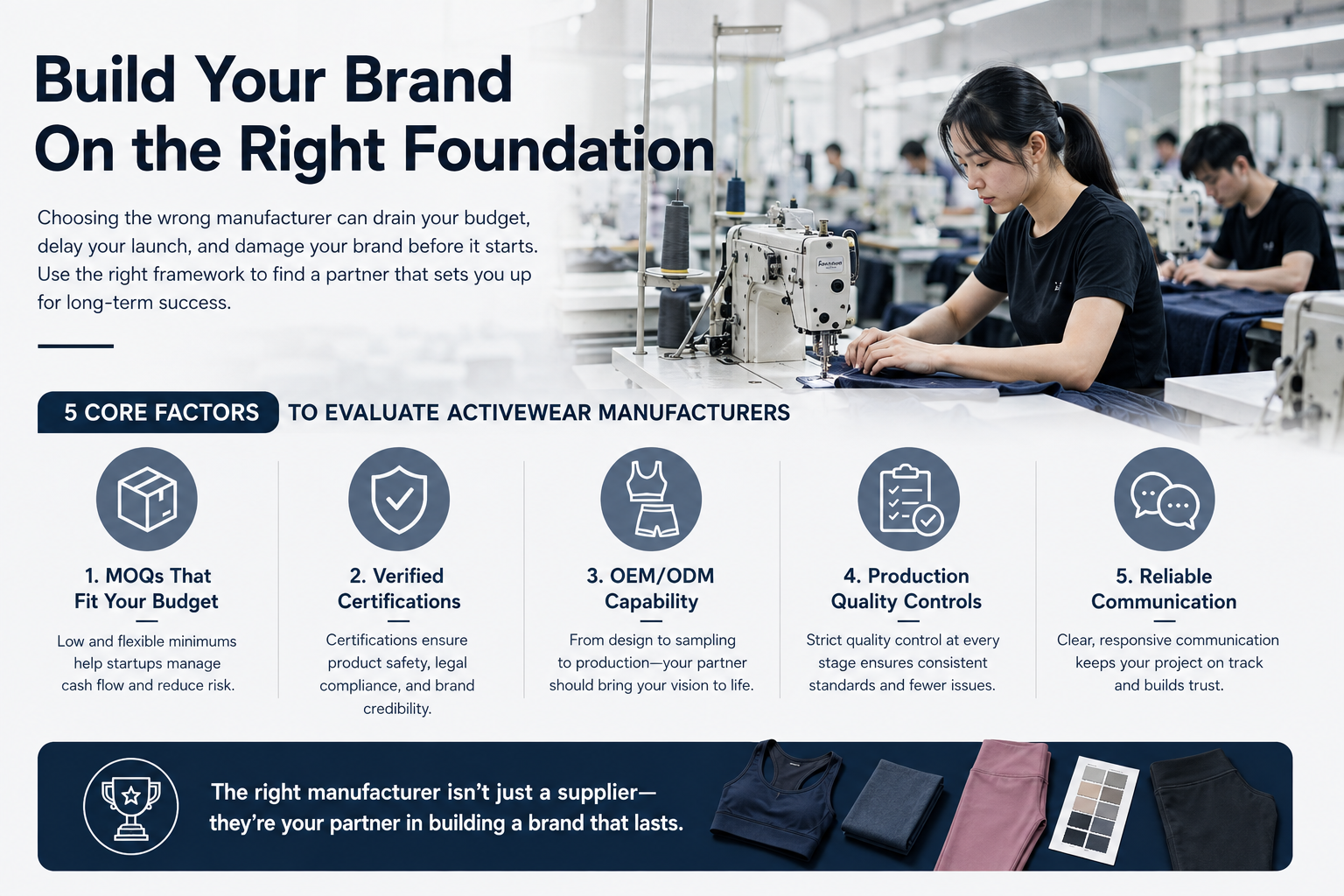
Choosing the right activewear manufacturer for a startup brand comes down to five core factors: minimum order quantities (MOQs) that fit your budget, verified certifications, OEM/ODM capability, production quality controls, and reliable communication. A manufacturer that checks all five boxes gives your brand a stable foundation to grow — without gambling your launch capital on unknowns.
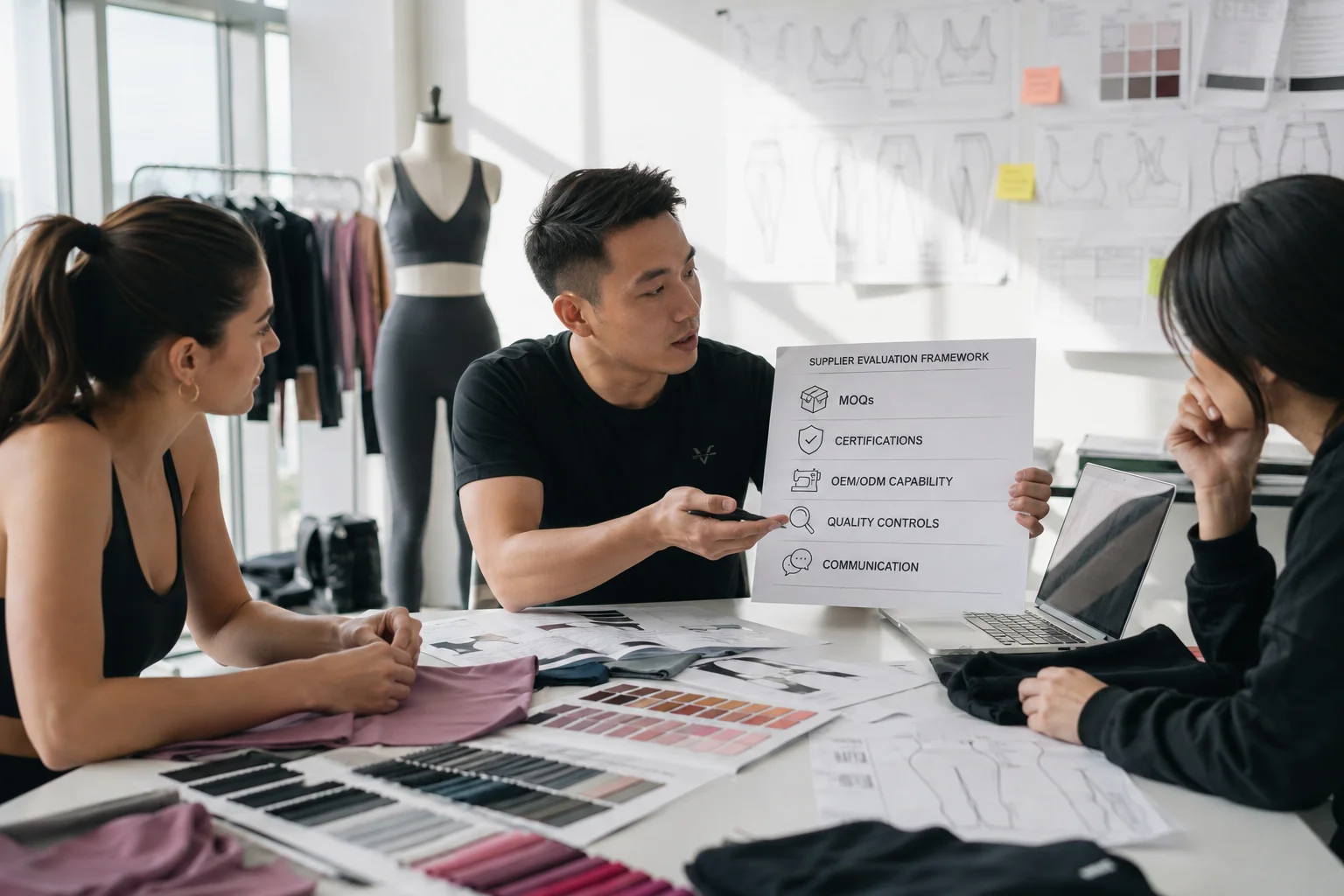
There's a lot more to unpack beneath that summary, though. Each factor has hidden layers that catch new brand founders off guard. Let's walk through them one by one — so you know exactly what questions to ask before you sign anything.
What Should a Startup Brand Look for in an Activewear Manufacturer?
New brand founders often shortlist suppliers based on price alone. That's usually a mistake that costs more to fix later.
The most important thing a startup should look for in an activewear manufacturer is a combination of low MOQ flexibility, transparent quality standards, and genuine OEM/ODM support. Price matters, but a manufacturer who can grow with your brand — handling small trial runs and scaling up — is worth far more than the cheapest quote.
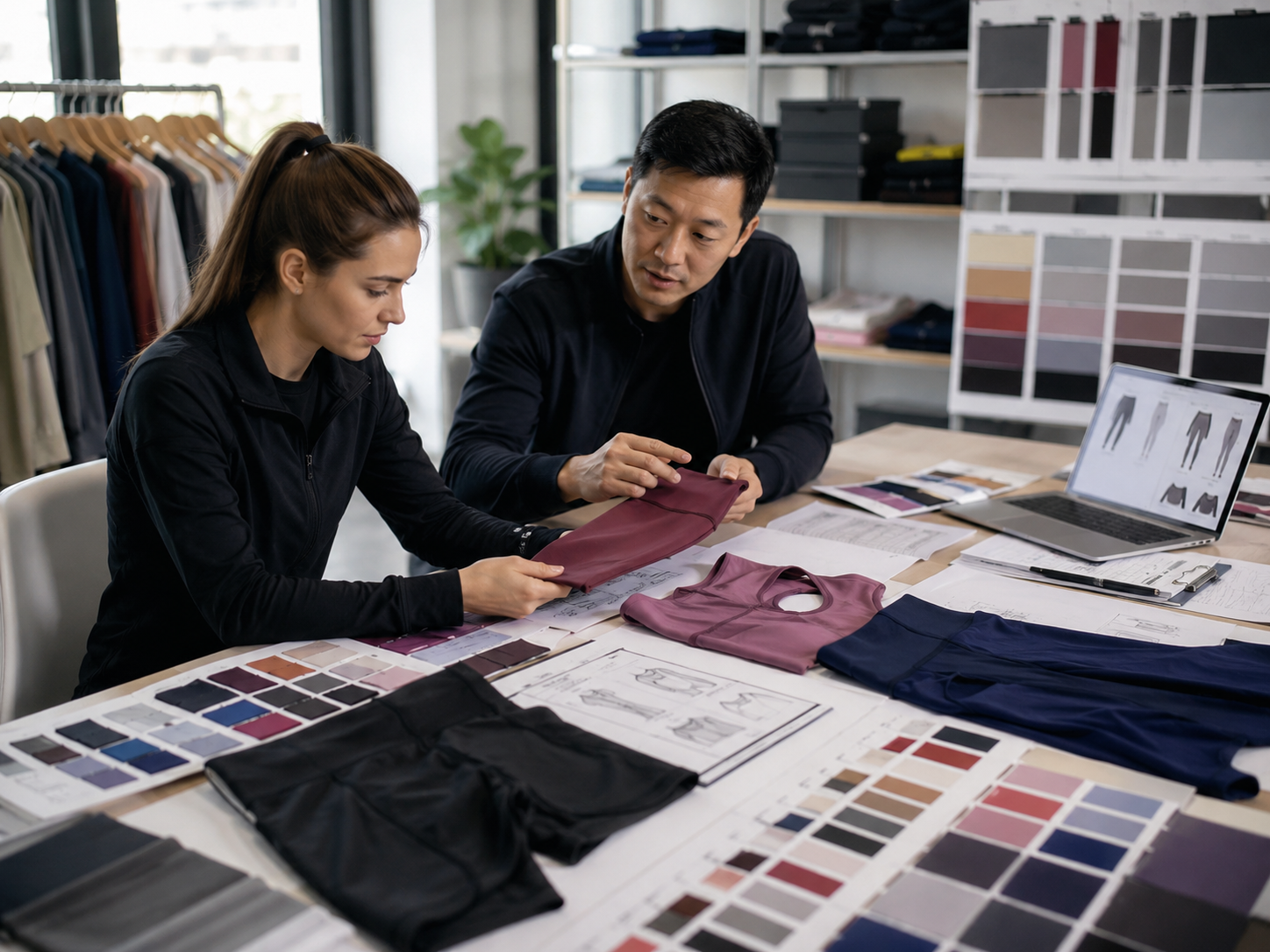
Most founders I talk to are surprised by how different "OEM" and "ODM" actually are in practice, and why that difference shapes everything from your launch timeline to your product differentiation. Before we get into certifications and MOQs, let's make sure those two terms are crystal clear.
OEM vs. ODM — Why the Difference Matters for Your Brand
These two terms sound similar but they put very different demands on both you and your manufacturer.
- OEM (Original Equipment Manufacturing):[^1] You provide the design, tech pack, and specifications. The manufacturer produces exactly what you specify. This gives you full creative control but requires you to have a design ready.
- ODM (Original Design Manufacturing):[^2] The manufacturer already has existing designs or templates. You customize them — colors, fabrics, logo placement, fit adjustments — and brand them as your own. This is faster and cheaper to start with.
For most startup brands, ODM is the smarter entry point[^3]. You reduce sampling costs, shorten your development timeline, and still end up with a product that looks and feels unique to your brand.
A manufacturer with a strong in-house design team can bridge the gap — taking your mood board or reference images and developing original samples without requiring a fully finished tech pack from you on day one.
What Questions Should You Ask Any Potential Manufacturer?
Before you even request a quote, run through this checklist:
| Question | Why It Matters |
|---|---|
| What is your MOQ per style? | Determines whether you can afford to test the market |
| Do you offer OEM, ODM, or both? | Shapes your design and development process |
| What certifications do you hold? | Impacts your ability to sell in regulated markets |
| What is your standard lead time? | Affects your launch and restock planning |
| What QC processes do you use? | Tells you how many defects to expect |
| Do you have in-house fabric sourcing? | Reduces supply chain risk for you |
| What is your sample cost and turnaround? | Signals how seriously they take small buyers |
How Do MOQs Affect a Startup Activewear Brand?
Cash flow is the number one killer of early-stage brands.[^4] MOQs sit right at the center of that problem.
Minimum order quantities (MOQs) directly control how much capital a startup must commit before knowing whether a product will sell. An activewear manufacturer with MOQs of 50–100 pieces per style lets founders test the market cheaply, while suppliers requiring 500+ pieces per style can lock up thousands of dollars in unsold inventory.
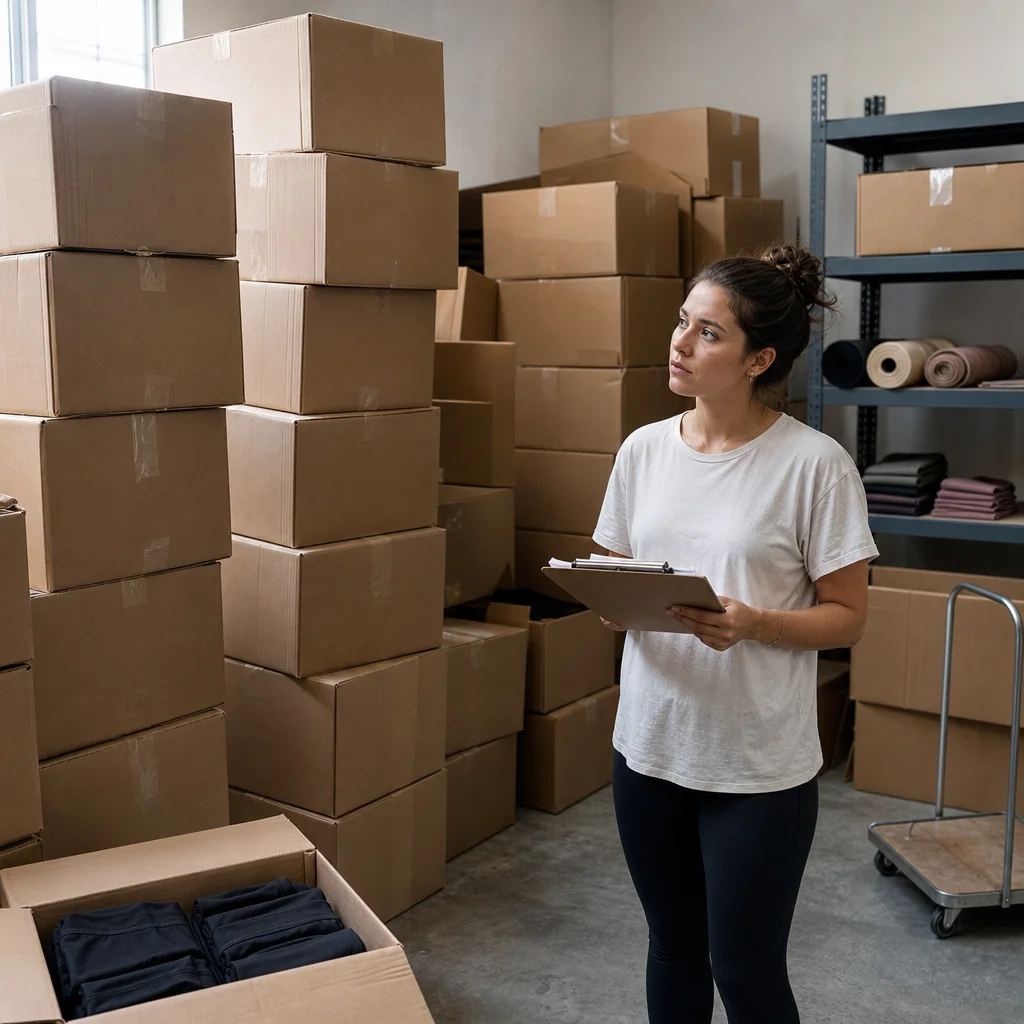
Understanding MOQ structure — not just the headline number — can save you from a nasty surprise when the invoice arrives.
Breaking Down MOQ Structure
Most manufacturers quote MOQ in one of three ways:
- Per style — e.g., 100 pieces of the same design regardless of color or size
- Per colorway — e.g., 50 pieces per color within a style
- Per SKU — e.g., 50 pieces per size per color (this is the most expensive for startups)
Per-SKU MOQs hit hardest. If a manufacturer requires 50 pieces per SKU and you want one legging style in 3 colors across 5 sizes, that's 750 pieces before you've sold a single unit.
How to Negotiate MOQ as a New Brand
Manufacturers set MOQs based on their production efficiency, fabric minimum purchases, and cutting waste. That means MOQ isn't always fixed — it's sometimes negotiable if you approach it right.
Here's what works:
- Consolidate your initial order. Instead of launching 10 styles, launch 3–4 and hit a higher total piece count. Manufacturers care more about total units than number of styles in many cases.
- Accept slightly higher unit prices for low-MOQ runs. A manufacturer running 50-piece samples will often agree if the margin makes it worthwhile for them.
- Start with ODM styles that already have patterns cut. When patterns are already developed, production setup costs are lower, which lowers the effective MOQ.
- Be upfront about growth plans. A founder who says "we want to start at 100 pieces to test, then scale to 1,000+ within six months" is a far more attractive client than one who just asks for the cheapest possible run.
At Dongguan Pro Sportswear, we support MOQs starting from 50–100 pieces for trial orders, specifically because we know that startup brands need room to test without betting everything on a first run.
Which Certifications Should You Verify Before Choosing an Activewear Manufacturer?
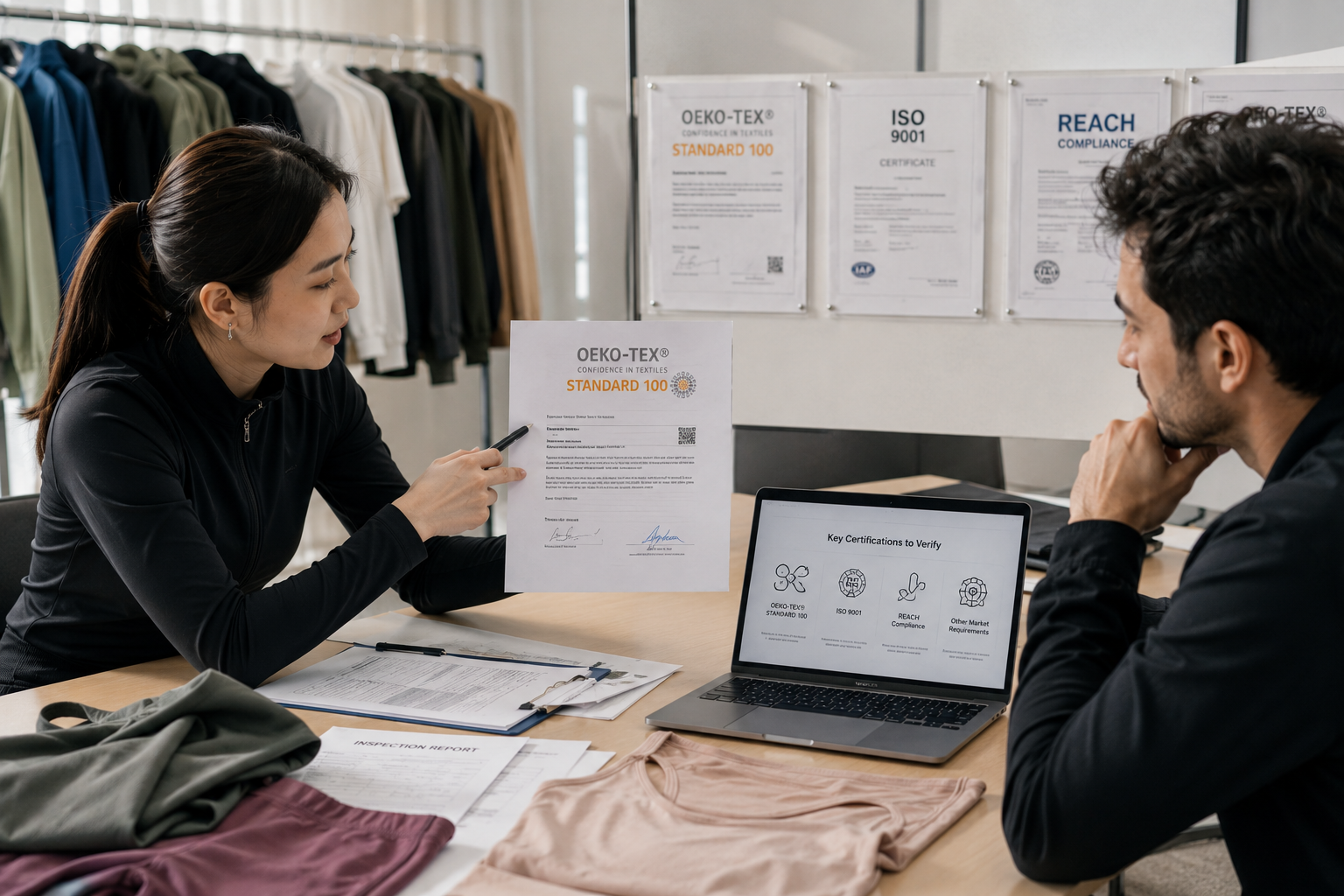
Certifications are documents. Don't take a supplier's word for it — ask to see the paperwork, check expiry dates, and if possible, verify directly with the issuing body.
Before partnering with any activewear manufacturer, buyers should verify certifications including OEKO-TEX® Standard 100, ISO 9001, REACH compliance, and any market-specific requirements. These documents confirm that fabrics are free from harmful substances and that the factory operates under auditable quality management systems[^5] — both critical for selling in the EU, US, and other regulated markets.
Why Each Certification Actually Matters to Your Business
Let me break down the key certifications and what they mean in practical terms for a startup founder.
OEKO-TEX® Standard 100
This is arguably the most recognized fabric safety certification globally. It tests for over 100 harmful substances — including banned dyes, heavy metals, and pesticides.[^6] If you're selling activewear in Europe or to health-conscious consumers, this is close to non-negotiable.
What to check: Look at the certificate scope. It should cover the specific fabrics used in your products, not just a generic facility approval.
ISO 9001
This is a quality management system standard. ISO 9001 certification tells you the factory runs documented processes — from raw material intake to final inspection.[^7] It doesn't guarantee zero defects, but it does mean problems get tracked and corrected systematically.
What to check: The certificate should be issued by an accredited body (like TÜV Rheinland or SGS). Certificates from unknown or unaccredited auditors carry much less weight.
REACH & AZO Compliance
REACH is the European Union's chemical regulation framework.[^8] AZO dye restrictions are part of REACH compliance. If you're selling in the EU — or to EU-based retailers — your manufacturer's fabrics need to meet these standards.
What to check: Ask for test reports, not just a declaration. Reports from accredited labs like SGS or Intertek are the industry standard.
Additional Standards Worth Asking About
| Certification | Relevance |
|---|---|
| PFAS-free testing[^9] | Growing requirement — especially in California and EU markets |
| RoHS | Mainly for products with electronic elements (e.g., smart fitness wear) |
| CE marking | Required for certain products sold in the EU |
| Green Product Certification | Useful for positioning eco-conscious brand angles |
Our factory holds TÜV Rheinland and SGS certifications, with compliance across OEKO-TEX®, ISO 9001, REACH, AZO, PFAS, and more. I recommend verifying all of these directly — both before you start and periodically throughout your partnership.
How Do You Evaluate the Production Quality of an Activewear Manufacturer?
Quality control is the gap between what's in your head and what ends up in your customer's hands. Closing that gap is the manufacturer's job — but you need to know how to audit it.
To evaluate an activewear manufacturer's production quality, request physical samples, review their in-line and final inspection processes, ask about stretch and wash testing protocols, and ideally conduct or commission a third-party factory audit before committing to a large order. Documented QC processes and multi-round inspection checkpoints are the clearest signs of a quality-serious factory.
!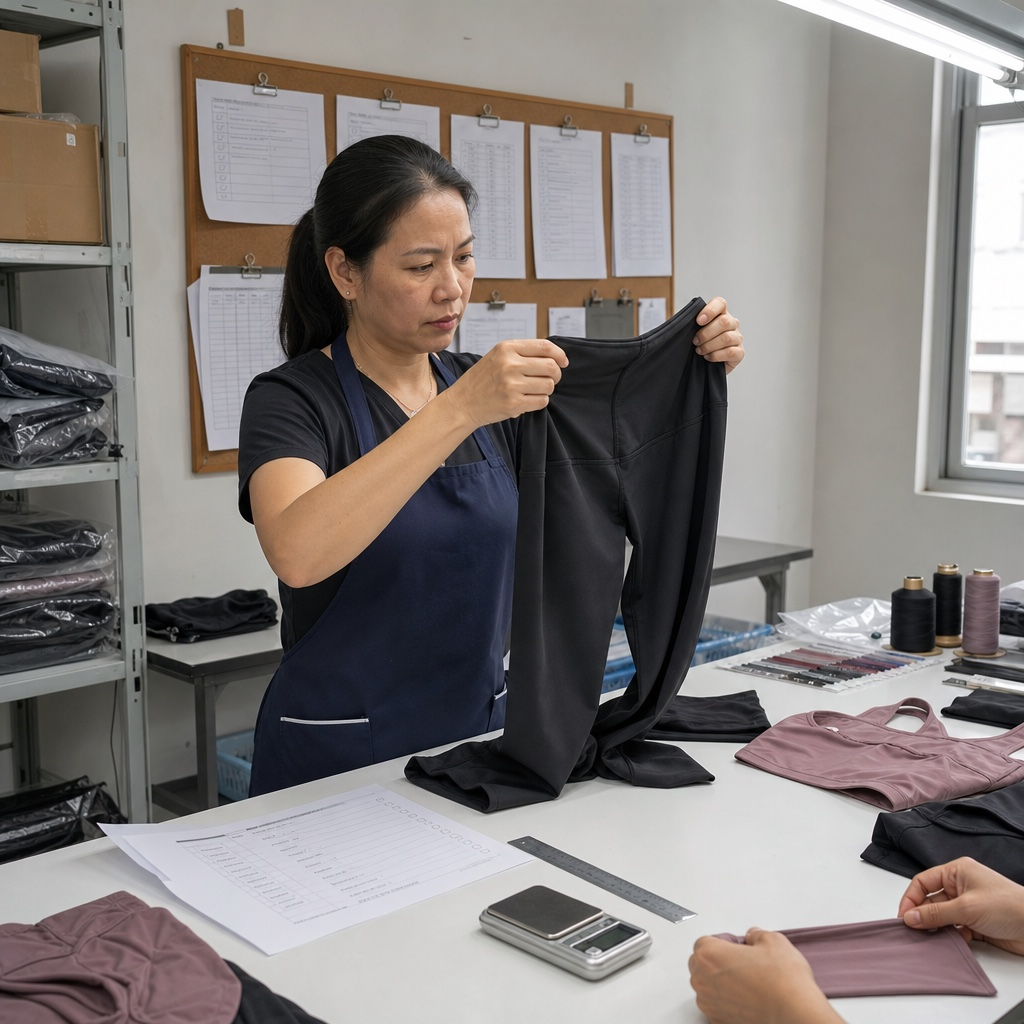
What a Proper QC Process Should Look Like
Here's the production quality control flow you should expect from any serious activewear manufacturer:
Stage 1 — Fabric Incoming Inspection
Before cutting begins, fabric rolls should be checked for:
- Color consistency (dye lot matching across rolls)
- Fabric weight (GSM testing)
- Stretch and recovery rates
- Surface defects (snags, holes, weaving errors)
If a factory skips incoming inspection, defects get built into the product from the very first step.
Stage 2 — In-Line Inspection During Sewing
Skilled QC staff should be checking during production, not just at the end. This catches errors like:
- Incorrect stitching patterns or stitch density
- Seam alignment issues
- Incorrect label placement
- Thread tension problems
Stage 3 — Final Product Testing
Before shipment, finished garments should pass:
- Dimensional testing — does the size medium actually measure correctly per your size spec?
- Wash testing — does the fabric shrink, bleed, or degrade after repeated washing?
- Stretch and recovery testing — does a high-waist legging maintain its hold after 50 wears?
- Pilling resistance — especially important for fleece-back fabrics used in yoga wear
- Seam strength testing — do flatlock seams hold under lateral stress during exercise?
What to Ask About Their Defect Rate
A reputable manufacturer should be able to quote you an AQL (Acceptable Quality Limit) standard they work to. AQL 2.5 is common in apparel[^10] — it means roughly 2.5% defect allowance in a given lot. For premium activewear brands, AQL 1.0 or 1.5 is a higher standard worth requesting.
The Sample Round Process — Read It Like a Report Card
How a manufacturer handles your sampling rounds tells you almost everything about how they'll handle production.
- Do they ask clarifying questions, or just produce something? Good factories ask questions. They want to understand your fit intention, not just copy a reference image.
- How quickly do they turn around a sample? Standard is 7–15 days for a first proto sample. Much longer than that signals capacity or organizational issues.
- How do they handle revision requests? One or two rounds of revisions is normal. A factory that gets defensive about changes is a red flag.
- Is the sample quality noticeably better or worse than production claims? Ask explicitly whether the sample was handmade by a sample room specialist, and whether production output will match. Sometimes there's a visible quality gap.
How Important Is Communication When Working With an Overseas Activewear Manufacturer?
Product quality gets the most attention in supplier evaluations. But I'd argue communication quality is what actually determines whether a partnership survives the first year.
Clear, responsive communication is essential when working with an overseas activewear manufacturer. Time zone gaps, language barriers, and unclear spec interpretation are the most common causes of production mistakes and missed deadlines.[^11] Before committing to a supplier, test their responsiveness, clarity, and willingness to document decisions in writing.
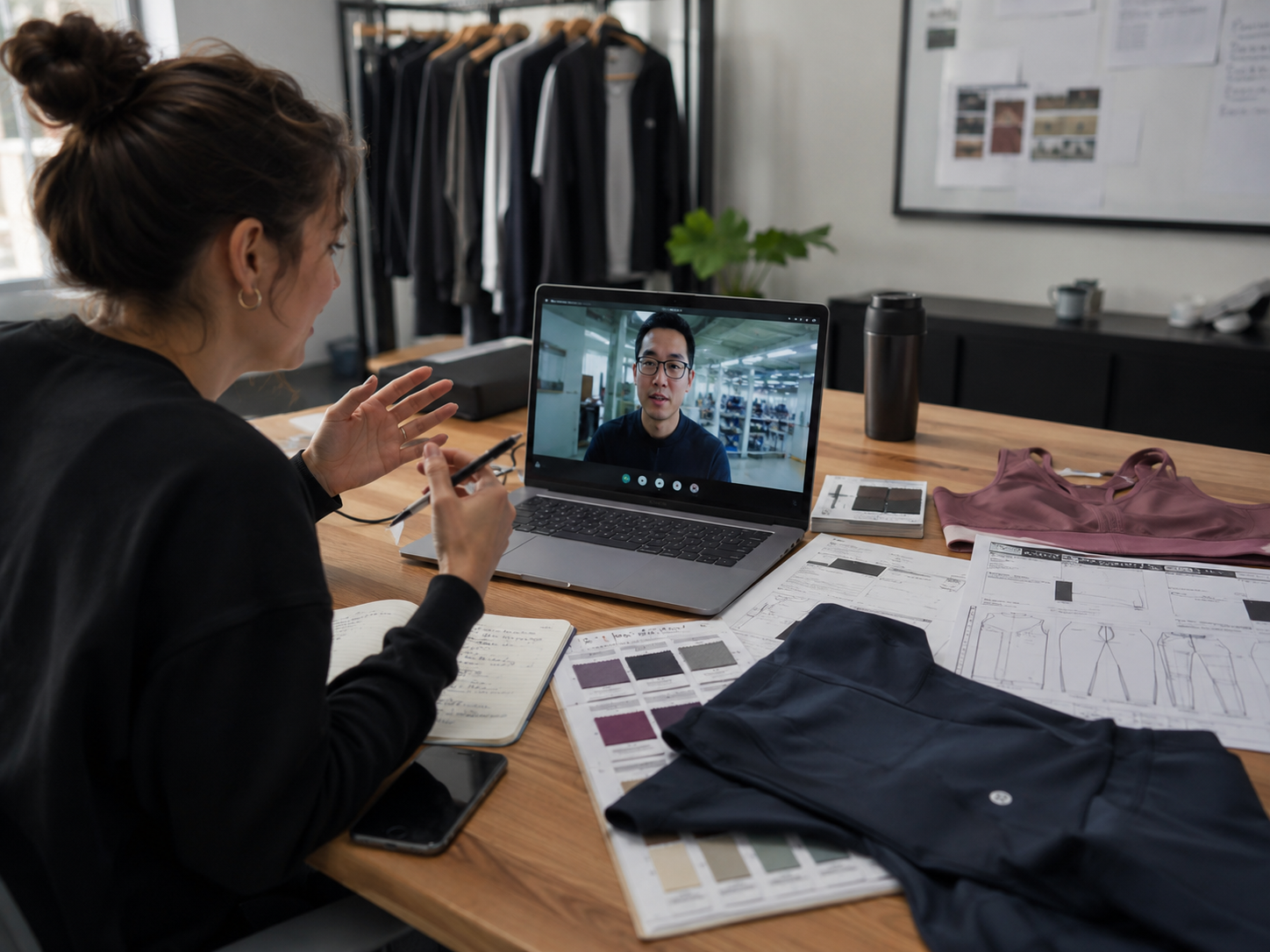
What Good Communication Actually Looks Like in Practice
I've seen founders lose weeks — and thousands of dollars — because of communication failures that were preventable. Here's what to watch for.
Responsiveness Window
When you send an initial inquiry, how long does the manufacturer take to respond? Industry standard is 24–48 hours for a first reply. Anything longer is a yellow flag. Anything under 12 hours with a detailed, relevant reply is a green flag.
Also check: do they respond on weekends or only business days? For international buyers in US or European time zones, a manufacturer that responds quickly early in the Chinese business day (which overlaps with US afternoon/evening) is significantly easier to work with.
Dedicated Account Management
The worst-case scenario for a startup is getting passed between different sales reps on every inquiry. You lose context, repeat yourself, and build no relationship. Ask upfront:
- Will I have a dedicated contact person for my account?
- Who is my backup contact if my main rep is unavailable?
- Who do I escalate to if there's a production issue?
Technical Communication Quality
Activewear has a precise technical language — fabric weights (GSM), stitch types (flatlock, overlock, coverstitch), waistband constructions, compression levels. A manufacturer's sales team should be able to discuss these fluently.
If you send a question about fabric composition and get a vague answer, that's often a sign the sales team doesn't have direct access to the technical team — which will slow everything down when problems arise during production.
Documentation Habits
Everything important should be in writing. This includes:
- Agreed specifications (tech pack sign-off)
- Sample approval comments
- Production timelines and milestones
- Shipping terms and responsibilities
- Revision records
Manufacturers who prefer to handle things verbally — via WeChat voice messages or verbal agreements on video calls — create unnecessary risk. Push for written confirmation of all decisions, even if it feels overly formal at first.
What Is the Full OEM/ODM Process From Concept to Delivery?
Understanding the full production process from idea to finished product helps you plan your timeline, budget, and expectations realistically.
The full OEM/ODM process for a startup activewear brand typically covers six stages: concept and design development, fabric selection, sample development and approval, bulk production, quality inspection, and shipment. End-to-end timelines range from 45 to 90 days depending on complexity, revision rounds, and order volume.
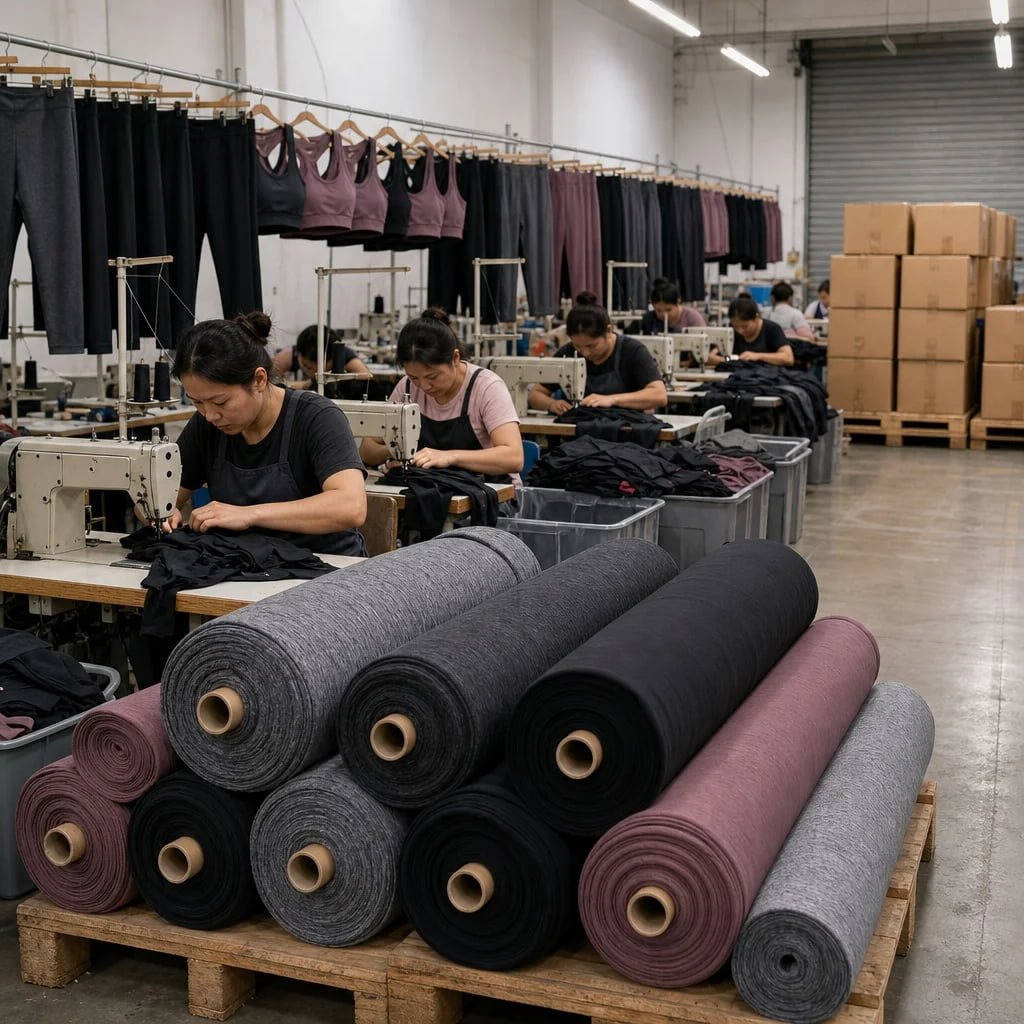
Stage-by-Stage Breakdown
Stage 1 — Concept and Design Development (1–2 weeks)
For ODM orders, this stage is fast — you're choosing from existing silhouettes and templates, then customizing colors, prints, and logo placement. For full OEM orders, you'll need to provide or co-develop a tech pack with detailed measurements, construction notes, and material specs.
Our 20-person design team handles full custom design development from mood boards and reference images. Each designer has 10+ years of activewear-specific experience, which means faster turnaround and fewer interpretation errors.
Stage 2 — Fabric Selection and Sourcing (overlaps with Stage 1)
Fabric sourcing is often underestimated by new brands. The right fabric choice affects:
- Performance — moisture-wicking, compression, breathability
- Feel — softness, stretch recovery, weight
- Compliance — certain markets require certified fabrics
- Cost — fabric is typically 40–60% of total product cost
Ask whether the manufacturer has in-house fabric sourcing relationships or relies entirely on third-party fabric agents. Manufacturers with direct mill relationships can offer better pricing, faster turnaround on fabric testing, and more control over lot consistency.
Stage 3 — Sample Development (2–3 weeks)
Expect 1–3 rounds of sampling for most new styles. Each round should refine fit, construction, and aesthetic until you're fully satisfied. Sign off samples only when you're genuinely happy — production will replicate what you approve.
Stage 4 — Bulk
[^1]: "OEM - Simple English Wikipedia, the free encyclopedia", https://simple.wikipedia.org/wiki/OEM. A general reference on original equipment manufacturing defines OEM arrangements as production in which one company manufactures components or products that are specified, branded, or sold by another company. Evidence role: definition; source type: encyclopedia. Supports: A neutral reference should define original equipment manufacturing as production carried out by one firm according to another firm's specifications or branding arrangement.. Scope note: This supports the general business definition of OEM, but not the article's specific activewear workflow. [^2]: "Original design manufacturer", https://en.wikipedia.org/wiki/Original_design_manufacturer. Reference definitions of original design manufacturing describe ODM suppliers as firms that design and manufacture products that another company may customize, brand, and sell. Evidence role: definition; source type: encyclopedia. Supports: A neutral source should define original design manufacturing as a model in which the manufacturer designs and produces goods that may be rebranded or customized by another company.. Scope note: This is definitional support and does not verify that ODM is always faster or cheaper for activewear startups. [^3]: "OEM vs ODM: Key Differences, Benefits, and How to Choose", https://jlccnc.com/blog/oem-vs-odm. Research and industry-neutral descriptions of ODM production note that relying on manufacturer-developed designs can reduce buyer-side design and development work compared with full custom OEM production. Evidence role: general_support; source type: research. Supports: A source should explain that ODM models can reduce development effort by using existing product designs, tooling, or templates.. Scope note: This would support the mechanism generally, not prove that ODM is the best choice for every startup activewear brand. [^4]: "Government and Financial Tech Can Fix Cash Woes for Small ...", https://www.library.hbs.edu/working-knowledge/government-and-financial-products-firms-can-ease-cash-flow-woes-for-small-businesses. Startup-failure research commonly identifies running out of cash or failing to secure financing as one of the most frequently cited reasons early-stage businesses fail. Evidence role: statistic; source type: research. Supports: A source should provide evidence that cash-flow shortages or running out of cash are among the most frequently reported causes of startup or small-business failure.. Scope note: The evidence may apply to startups broadly rather than specifically to activewear brands. [^5]: "EU REACH - International Trade Administration", https://www.trade.gov/eu-reach. Certification and regulatory sources describe OEKO-TEX Standard 100 as a textile harmful-substance testing system, ISO 9001 as a quality-management standard, and REACH as the European Union framework for chemical-substance control. Evidence role: general_support; source type: institution. Supports: Sources should confirm that OEKO-TEX Standard 100 addresses harmful substances in textiles, ISO 9001 concerns quality-management systems, and REACH regulates chemical substances in the EU.. Scope note: The combined citation would support the functions of the standards, but each supplier certificate still requires separate verification for scope, validity, and issuing body. [^6]: "OEKO-TEX® STANDARD 100", https://www.oeko-tex.com/en/our-standards/oeko-tex-standard-100/. OEKO-TEX documentation states that Standard 100 tests textile articles for a broad catalogue of harmful substances, including regulated and non-regulated chemicals relevant to human health. Evidence role: definition; source type: institution. Supports: The official OEKO-TEX source should state the number or categories of harmful substances covered by Standard 100 testing.. [^7]: "ISO 9001:2015 - Quality management systems", https://www.iso.org/standard/62085.html. ISO describes ISO 9001 as a standard specifying requirements for a quality-management system, including process control, documentation, monitoring, and continual improvement. Evidence role: definition; source type: institution. Supports: An ISO or accredited standards source should confirm that ISO 9001 specifies requirements for a quality-management system, including documented and controlled processes.. Scope note: ISO 9001 certification supports the presence of a management system, but it does not by itself prove that a particular shipment will be defect-free. [^8]: "Registration, Evaluation, Authorisation and Restriction of ...", https://en.wikipedia.org/wiki/Registration,_Evaluation,_Authorisation_and_Restriction_of_Chemicals. The European Chemicals Agency explains that REACH is the European Union regulation governing the registration, evaluation, authorization, and restriction of chemical substances. Evidence role: definition; source type: government. Supports: An EU source should define REACH as the European Union regulation for registration, evaluation, authorization, and restriction of chemicals.. [^9]: "AB 1817 - California Legislative Information", https://leginfo.legislature.ca.gov/faces/billTextClient.xhtml?bill_id=202120220AB1817. Regulatory materials from California and European authorities show increasing restrictions and proposals targeting PFAS in consumer products, including textile and apparel categories. Evidence role: historical_context; source type: government. Supports: Government sources should show that California and EU authorities have adopted or proposed restrictions affecting PFAS in textiles or consumer products.. Scope note: The citation would establish regulatory context, but specific testing obligations depend on product type, chemical use, and effective dates. [^10]: "Acceptable Quality Limit, AQL", https://www.qima.com/aql-acceptable-quality-limit. Quality-inspection standards based on AQL sampling use numerical acceptance limits such as 2.5 to determine lot acceptance thresholds for inspected goods, and garment-inspection guidance commonly applies AQL levels to apparel defect categories. Evidence role: definition; source type: institution. Supports: A standards or quality-control reference should explain AQL sampling and indicate that AQL 2.5 is commonly used for major defects in garment inspection.. Scope note: This supports the use and meaning of AQL levels, but 'common in apparel' may vary by buyer, product category, and defect classification. [^11]: "Language barriers as a reported cause of prehospital care ...", https://pubmed.ncbi.nlm.nih.gov/18189182/. Research on global sourcing and offshore production identifies communication barriers, coordination delays, and specification misunderstandings as factors that can increase production errors and schedule risk. Evidence role: mechanism; source type: paper. Supports: A peer-reviewed source should show that communication barriers, coordination gaps, or cultural and language differences increase risk in global sourcing and offshore production.. Scope note: The evidence is likely to address international manufacturing generally rather than activewear manufacturing specifically.